
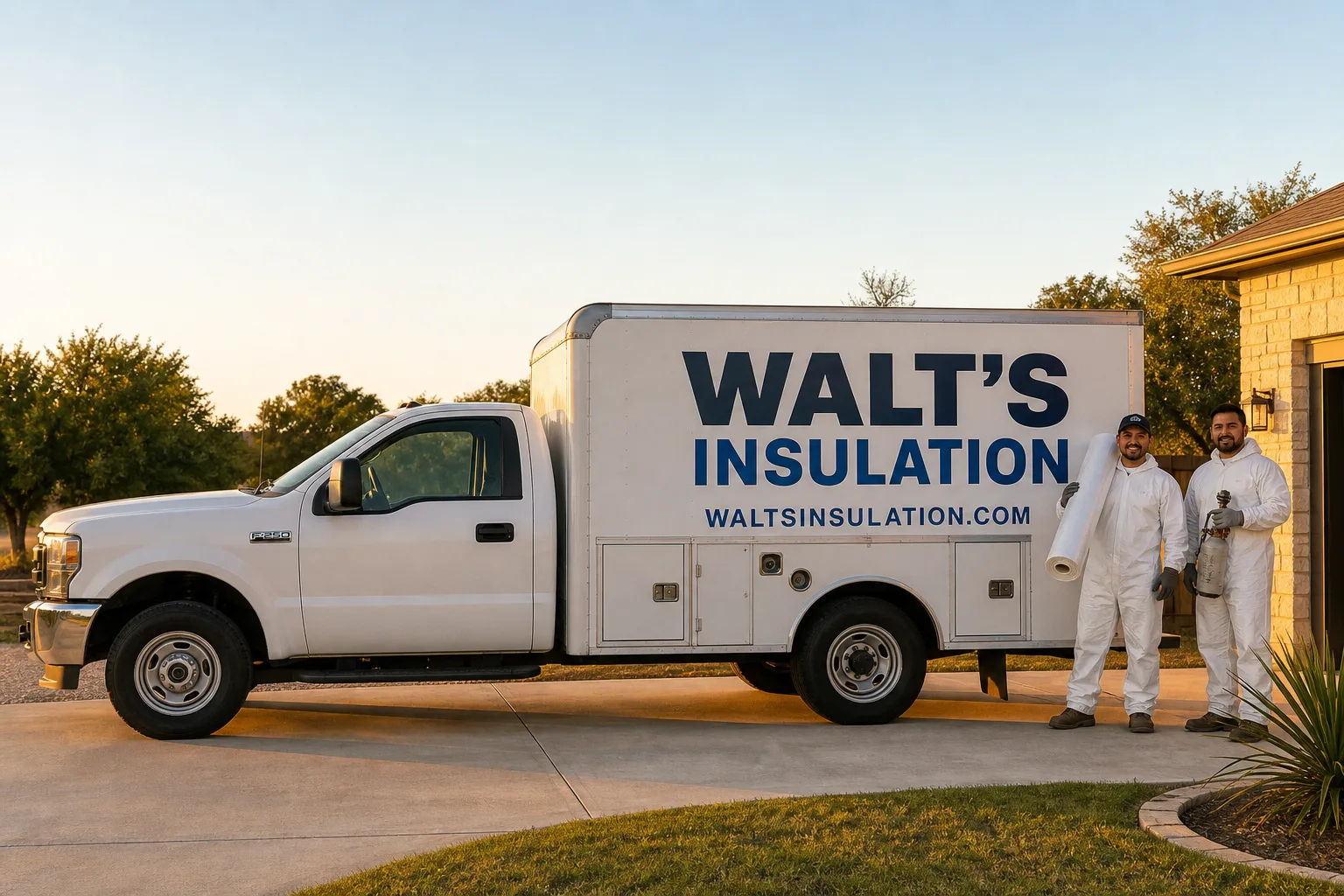
How Much Does Blown-In Insulation Cost in San Antonio?
Our Blown-In Insulation services in San Antonio typically cost between $1,200 and $3,800 for a standard attic, with most homeowners landing around $1,800 to $2,400 for a 1,500-square-foot attic brought up to the R-38 to R-49 depth that Bexar County homes actually need. The exact number depends on your current R-value, attic access, and which material – fiberglass or cellulose – makes sense for your house. For a free, no-obligation estimate on your specific home, call Walt’s Insulation at (866) 751-4428.
Blown-In Insulation Cost Breakdown (2026)
Here is how San Antonio pricing breaks down by square footage and material type, based on what we see on real jobs across Bexar County. These ranges reflect a complete installation – no hidden fees, no “we’ll add that at the end” surprises.
| Attic Size | Blown-In Fiberglass (per sq ft ~$1.00-$1.60) | Blown-In Cellulose (per sq ft ~$0.85-$1.40) | Typical Total Range |
|---|---|---|---|
| 800 sq ft | $800 – $1,280 | $680 – $1,120 | $900 – $1,500 |
| 1,000 sq ft | $1,000 – $1,600 | $850 – $1,400 | $1,100 – $1,800 |
| 1,500 sq ft | $1,500 – $2,400 | $1,275 – $2,100 | $1,600 – $2,800 |
| 2,000 sq ft | $2,000 – $3,200 | $1,700 – $2,800 | $2,100 – $3,500 |
| 2,500 sq ft | $2,500 – $4,000 | $2,125 – $3,500 | $2,600 – $4,200 |
A few things are baked into those numbers: labor, material, equipment setup, and basic attic prep. What can push your quote higher is attic air sealing before the blow-in (typically $400 to $900 additional, but almost always worth doing), old fiberglass batt removal if the existing insulation is contaminated or compressed down to nothing (add $600 to $1,500 depending on volume), and access difficulties in older homes with low-pitch rooflines common in neighborhoods like Olmos Park and Alamo Heights.
On the material side, fiberglass blown-in from manufacturers like Owens Corning or Johns Manville is slightly more expensive per bag but resists moisture absorption well – something that matters in San Antonio where summer humidity can spike fast even in a ventilated attic. Cellulose from brands like GreenFiber or Knauf is typically 10-15% cheaper per square foot and has strong green credentials, but it needs to be dry when installed and it can settle slightly over the first year. Either material, installed properly and to the right depth, will do its job for decades.
If you need a rough ballpark right now: a 1,500-square-foot San Antonio home with a reasonably accessible attic, no existing removal, and a target of R-38 will usually come in at $1,600 to $2,200 with blown-in fiberglass and slightly less with cellulose. That is the number we see most often on residential jobs across Bexar County.
What Affects Blown-In Insulation Pricing in San Antonio
No two attics are the same, and San Antonio homes in particular have some quirks that show up in pricing more often than homeowners expect. Here are the factors that matter most:
- Current R-value and starting depth: San Antonio falls in IECC Climate Zone 2, and the Department of Energy recommends R-38 to R-60 for attics in this zone. If you’re starting from R-13 or less – which is common in 1970s and 1980s construction in neighborhoods like Stone Oak and Helotes – you need more material, more labor, and a higher bag count. The lower your starting point, the bigger the price.
- Attic size and square footage: This is the most direct cost driver. More square footage equals more bags of material and more time. Larger homes in areas like the Hill Country Village or newer developments off Loop 1604 can see attic footprints over 2,500 square feet, which brings costs up accordingly.
- Attic access and layout: A pull-down stair with a clear opening and a walkable attic floor keeps labor costs down. A single scuttle hole, low rafters, or attic joists packed with HVAC equipment slow everything down. We see a lot of cramped attic conditions in older homes near the Medical Center and in historic Southtown bungalows, and that extra labor time is reflected in the quote.
- Existing insulation condition: If what’s there is rodent-contaminated, wet, or so degraded it’s doing nothing, it needs to come out before we blow in new material. Removal adds cost but is not optional in those situations – blowing new insulation over damaged old insulation is exactly the kind of shortcut that leads to callbacks and failed jobs. Walt’s Done Right Promise means we don’t take that shortcut.
- Attic air sealing: In San Antonio’s heat, your attic is under tremendous thermal pressure from May through September. If you seal the air bypasses before adding insulation – around recessed lights, top plates, plumbing penetrations – you capture most of the efficiency gains. Skipping it leaves money on the table. We quote air sealing separately so you can see exactly what it adds.
- Radiant barrier interaction: Many San Antonio attics either have or need a radiant barrier on the roof deck. If one is already in place, blown-in insulation works alongside it without any changes. If you’re adding both on the same job, we can often reduce the required blown-in depth slightly, which partially offsets the combined project cost. This is a San Antonio-specific conversation you won’t hear from contractors who work primarily in cooler markets.
- Material choice and bag count: Fiberglass and cellulose are priced differently, and different R-value targets require different settled depths. Blown-in fiberglass from Owens Corning, for example, requires a different bag count per square foot to hit R-38 than cellulose from GreenFiber. We’ll walk you through the math on your estimate so there are no surprises.
San Antonio Market Specifics: What Makes This City Different
San Antonio’s climate is not Phoenix-dry or Houston-humid – it sits in an awkward middle ground that creates specific insulation challenges. Summers average 100 days above 90°F, attic temperatures regularly hit 140-160°F from June through August, and then January brings cold snaps that can drop overnight lows into the 20s. That temperature swing in a single year is larger than most northern cities see, and it’s why insulation depth matters so much here.
We also see a lot of homes in San Antonio built during the 1980s and 1990s construction boom – the suburbs of Leon Valley, Converse, Live Oak, and Universal City are full of them – that were originally insulated to R-19 or R-22. That was code-compliant at the time. In 2026, those homes are leaving serious money on the table every month in HVAC costs, and a blown-in top-up job to reach R-38 or R-49 is one of the fastest-payback home improvements you can make in this market.
CPS Energy, San Antonio’s municipal utility, has periodically offered rebate programs for insulation upgrades. The availability and amounts change year to year, so we recommend checking directly with CPS at the time of your estimate. We’ll help you identify any current offers that apply to your job.
Permit requirements for blown-in insulation in Bexar County are minimal for attic-only work – a building permit is generally not required for adding insulation to an existing attic, though this can vary if you’re doing associated structural or electrical work at the same time. We handle all required documentation and keep records on file so you have a clear paper trail for any future home sale.
How to Save on Blown-In Insulation in San Antonio
A few concrete ways to lower your out-of-pocket cost without cutting corners on the job itself:
- Get a second opinion on any written estimate. Walt’s offers a free second opinion on any written quote you’ve already received – no trip charge inside Bexar County. If another contractor gave you a number that seems high or low, we’ll look at it and tell you straight what we see. Call (866) 751-4428 to set that up.
- Bundle attic air sealing with your blown-in job. Doing both at once keeps mobilization costs down. Scheduling them separately means paying for two setup visits and two rounds of equipment. The savings aren’t massive, but they’re real – typically $150 to $300 compared to two separate jobs.
- Ask about the 10% senior and veteran discount. Walt’s applies this permanently, on every job – not as a limited-time promotion. If you or a spouse served or are 65 or over, just mention it when you call. It applies to the full job total.
- Check CPS Energy’s current rebate offerings. San Antonio homeowners have access to utility-backed incentives that reduce the net cost of insulation upgrades. The amounts and eligibility shift periodically, so the best time to check is right before you schedule your install.
- Time your project for late fall or winter. Demand for insulation work in San Antonio peaks in late spring as homeowners realize their AC is already struggling. Scheduling your job between November and February often means faster scheduling and – with some contractors – better pricing flexibility. We keep pricing consistent year-round, but your timeline flexibility makes scheduling easier for everyone.
- Don’t skip air sealing to save money upfront. This sounds counterintuitive, but homeowners who skip air sealing and then call us back in two summers because the house still isn’t comfortable end up paying more in total. Doing it right the first time – sealed and insulated – is the more economical path over a five-year horizon.
For a free, no-pressure estimate on your San Antonio home, call (866) 751-4428. A live person answers every call – not a voicemail, not an answering service. We can usually get someone out for an assessment within a day or two, and we’ll give you a written, line-item quote before any work starts.
Blown-In vs. Batt Insulation: Is Blown-In Worth It in San Antonio?
This question comes up often, particularly from homeowners considering a DIY top-up with fiberglass batts from a big-box store. Here’s the honest answer: for attic applications in San Antonio, blown-in almost always performs better than batts, and here’s why.
Blown-in material – whether fiberglass or cellulose – conforms to every irregular joist bay, fills around wiring and pipes, and covers the entire attic floor with no gaps. Fiberglass batts, even when installed carefully, leave air channels at the edges and corners. In a San Antonio attic that’s hitting 150°F, those gaps are where your conditioned air escapes.
The cost difference between the two approaches is real but narrower than most people assume. A professional blown-in job to R-38 over 1,500 square feet might cost $1,600 to $2,200. DIY batt installation for the same coverage might run $600 to $900 in materials plus your time – but if the installation isn’t consistent, you could end up with effective performance well below R-38, and no workmanship coverage if the performance disappoints. Walt’s Done Right Promise covers our blown-in work for life. The batt job you do yourself has no safety net.
There are situations where batts make sense – open wall cavities before drywall goes up, for example. But for attic top-ups and full replacements in San Antonio’s climate, blown-in is almost always the right call. Our Blown-In Insulation in San Antonio service page has more detail on material options and what a typical job looks like from start to finish.
Blown-In Insulation and San Antonio’s Summer Heat: The Numbers Behind the Decision
Let’s put some numbers on the efficiency question. The average San Antonio household spends roughly $180 to $220 per month on electricity in summer. HVAC accounts for 40-50% of that in a typical home – so call it $80 to $110 a month just in cooling. Studies by the Oak Ridge National Laboratory and the North American Insulation Manufacturers Association consistently show that properly air-sealed and insulated attics can reduce HVAC-related energy use by 15-25% in hot climates.
On a $100-per-month cooling bill, 20% savings is $20 a month – $240 a year. A $1,800 blown-in job pays for itself in cooling savings alone in roughly 7 to 8 years, and San Antonio’s heat means those savings are front-loaded in the May-through-September window when your system is working hardest. The payback is often faster than those conservative estimates suggest because attic temperatures in our market are more extreme than the averages those studies use.
None of this counts the reduced wear on your HVAC system – shorter runtimes mean fewer repair calls and a longer equipment lifespan. It also doesn’t count the comfort improvement: a properly insulated San Antonio home holds temperature more consistently, which matters especially in the rooms over an uninsulated garage or at the end of a long duct run.
What the Installation Process Looks Like
Knowing what you’re paying for makes it easier to evaluate quotes, so here’s how a standard blown-in attic job works at Walt’s Insulation:
- Assessment and measurement: We pull measurements of your attic, check existing R-value with a probe, document any air leaks, moisture issues, or pest activity, and note access conditions. This is the basis for the written quote.
- Air sealing (if included): Before any insulation goes in, we foam and seal top-plate gaps, recessed light penetrations, plumbing chases, and any other bypasses we found in the assessment. This step takes anywhere from one to three hours depending on the home.
- Baffles and blocking: We verify that soffit baffles are in place to maintain attic ventilation at the eaves. Without these, insulation can block airflow and cause moisture buildup – a problem we see regularly in older San Antonio homes where original baffles were never installed.
- Blow-in: Material goes in from the far corners toward the attic hatch. We use depth gauges set at the required settled depth for the target R-value so there’s no guesswork. A typical 1,500-square-foot attic takes one to three hours to blow, plus setup and cleanup.
- Final check and documentation: We photograph the finished depth against the gauges, document the bag count, and leave you a written record of the installed R-value. That documentation matters for home sales and any utility rebate applications.
Background-checked, uniformed technicians handle every step. You’ll know who’s on the job before they arrive, and Walt’s team answers questions before, during, and after – at (866) 751-4428, a live person picks up every time.
FAQs – Blown-In Insulation Cost in San Antonio
How much does blown-in insulation cost per square foot in San Antonio?
Blown-in insulation in San Antonio runs $0.85 to $1.60 per square foot for the material and installation, depending on whether you choose cellulose or fiberglass and the target R-value. Cellulose from brands like GreenFiber or Knauf sits at the lower end; blown-in fiberglass from Owens Corning or Johns Manville runs slightly higher. For a 1,500-square-foot attic, that translates to roughly $1,275 to $2,400 before any add-ons like air sealing or removal. Call (866) 751-4428 for a free estimate – we’ll give you a written number for your specific attic, not a per-square-foot range.
Is it cheaper to repair or fully replace old attic insulation in San Antonio?
If existing insulation is simply thin or settled – common in San Antonio homes built between 1975 and 1995 – a top-up with blown-in material is almost always cheaper than full replacement, typically $800 to $1,800 less depending on attic size. Full replacement only makes economic sense when existing material is contaminated (rodent droppings, moisture damage, mold), degraded beyond recovery, or when you need the attic floor clear for air sealing work. We’ll tell you honestly which category your attic falls into during the assessment – we don’t upsell removal when a top-up will do the job. Call (866) 751-4428 for a second opinion if you’ve already been quoted a full removal and want a straight answer.
Can you get blown-in insulation installed the same week in San Antonio?
Yes, in most cases. Walt’s Insulation typically schedules assessments within one to two business days and can complete most residential blown-in jobs within a week of the estimate. Peak season – April through June – is our busiest window as San Antonio homeowners scramble before the heat hits, so scheduling flexibility improves in fall and winter. Call (866) 751-4428 and we’ll tell you exactly what the current lead time looks like – a live person will answer and give you a real answer, not a form submission.
What R-value do I need for blown-in insulation in San Antonio?
The Department of Energy recommends R-38 to R-60 for attics in San Antonio’s Climate Zone 2. Most San Antonio homes built before 2000 have somewhere between R-11 and R-22, which is well below current recommendations. R-38 is the practical minimum for a comfortable, energy-efficient home in our summer heat; R-49 or R-60 makes sense for homes with older HVAC systems, significant cooling loads, or homeowners planning to stay long-term. We’ll measure what you currently have and recommend the target depth in writing during your free estimate. Call (866) 751-4428 to set that up.
Does Walt’s Insulation offer any discounts on blown-in insulation in San Antonio?
Yes – seniors and veterans receive a permanent 10% discount on all work, every job, no expiration date. We also offer a free second opinion on any written estimate you’ve received from another contractor, with no trip charge inside Bexar County. And any repair or add-on work over $200 gets $40 off – that applies to things like attic air sealing billed as part of a larger project. These are standing offers, not limited-time promotions. Just mention which apply to you when you call (866) 751-4428.
How long does blown-in insulation last in a San Antonio attic?
Properly installed blown-in fiberglass from manufacturers like Owens Corning or Johns Manville maintains the vast majority of its R-value for 20-30 years or more under normal attic conditions. Cellulose from GreenFiber or Knauf settles slightly in the first year – typically 3-5% – which is why we install slightly above the target depth to account for settling. San Antonio’s heat and humidity create more demanding conditions than cooler climates, so ventilation quality and air sealing both affect longevity. Walt’s Done Right Promise covers our workmanship for the life of the installation – if something we installed doesn’t perform as it should, we make it right. Call (866) 751-4428 if you have questions about an existing installation.
Key Takeaways
- Blown-in insulation in San Antonio costs $1,200 to $3,800 for most residential attics, with a typical job landing between $1,600 and $2,400.
- Per-square-foot rates run $0.85 to $1.60 depending on material and target R-value.
- San Antonio sits in Climate Zone 2; the recommended attic R-value is R-38 to R-60.
- Most homes built before 2000 in Bexar County neighborhoods like Stone Oak, Helotes, Leon Valley, and Converse are underinsulated and good candidates for a blown-in top-up.
- Adding attic air sealing at the same time typically costs $400 to $900 more but provides the biggest efficiency gains.
- Walt’s Insulation offers a 10% senior and veteran discount, a free second opinion, and no trip charge inside Bexar County.
- All work is covered by the Done Right Promise – lifetime workmanship, no runaround.
- A live person answers at (866) 751-4428 around the clock, every day.
Ready to Get an Exact Price for Your San Antonio Home?
Ranges are useful for planning, but the only number that actually matters is the one for your attic, your square footage, and your current insulation situation. Walt’s Insulation has been working in San Antonio and Bexar County since 2000, and we’ve seen every attic configuration this city has to offer – from historic Southtown bungalows with original 1950s insulation to sprawling 2,800-square-foot builds off 1604 that were underinsulated from the day they were built.
We’re a locally owned, owner-operated business with a real published address, a real license number, and a real phone number that a real person answers – day or night. No voicemail, no answering service. If you want more background on what the installation actually involves, our Blown-In Insulation in San Antonio page walks through the full service. And if you’d like to see everything we offer for San Antonio homeowners, the home page is a good place to start.
Call (866) 751-4428 to schedule your free estimate. We’ll come out, measure your attic, check your current R-value, and give you a written quote with line-item pricing before anything starts. No pressure, no vague ranges, no surprises on the invoice. That’s the Walt’s way – and it has been since 2000.
Pricing reflects the San Antonio market as of 2026. Walt’s Insulation offers free estimates – call (866) 751-4428.
Written by Walt Brenner, Owner at Walt’s Insulation, serving San Antonio since 2000.
What Our Customers Say
"Radiant barrier and new insulation in one visit. Walt explained what the foil actually does and what it does not, which nobody else bothered to. Electric bill in July was the lowest it has been in this house."
- Nadia Haddad"Air sealing first, then blown-in over the top. He found a bathroom fan venting straight into the attic and fixed that too. Written price before they started, same price when they finished."
- Arjun Mehta"Spray foam in the garage ceiling under the bonus room. That room used to be unusable in summer. Walt talked me out of foaming the whole attic because it did not need it - saved me a couple thousand and I trust him more for it."
- Bud Larkin